
Every moment could be our last opportunity in life, and this acknowledgement gives weight to our actions while stripping away trivial distractions.
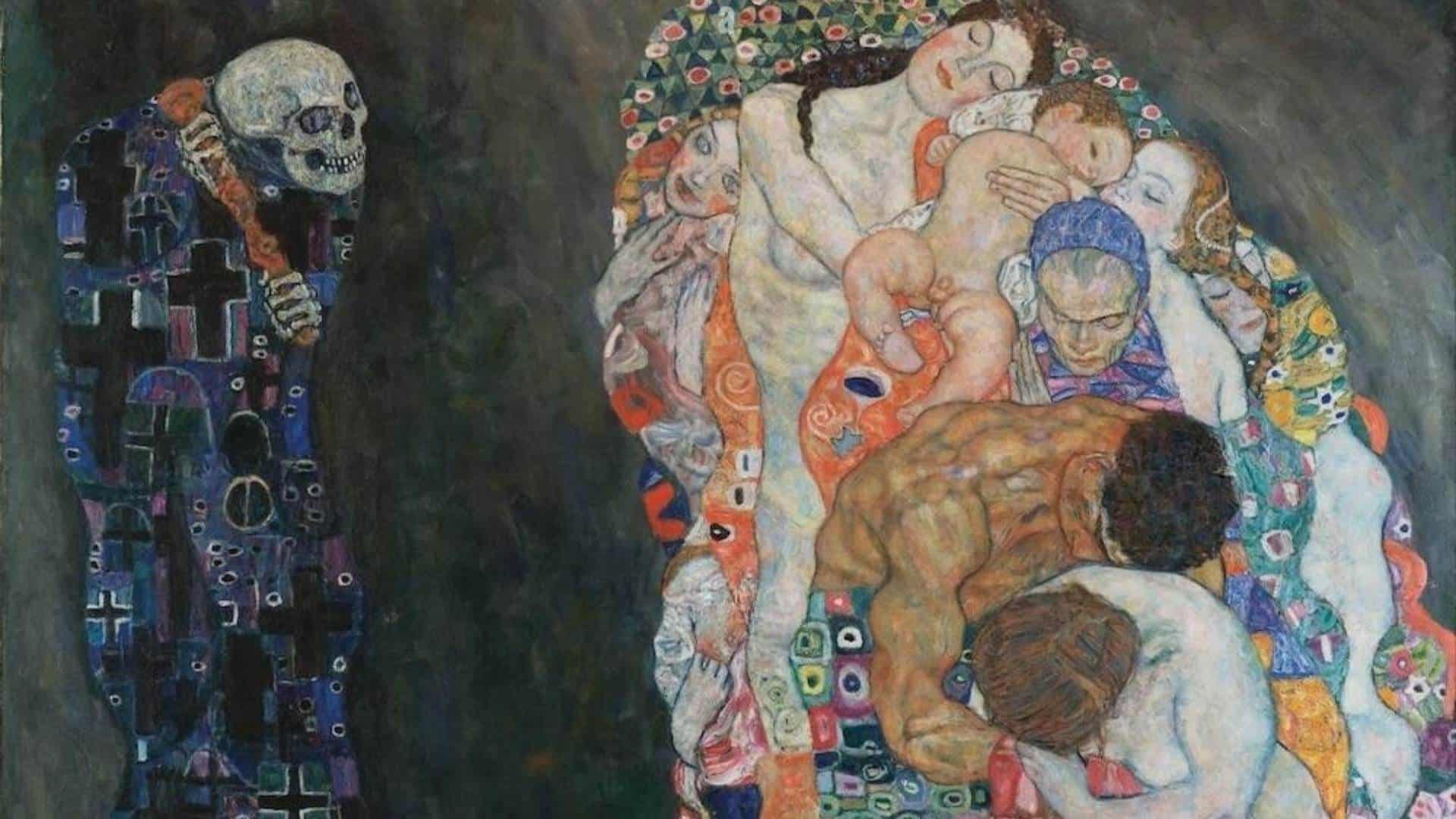
A section of the painting “Death And Life” by Gustav Klimt, 1908.
This article by student Jack Kapund Kambale was produced out of News Decoder’s school partnership program. Jack is a student at African Leadership Academy in South Africa, a News Decoder partner institution. Learn more about how News Decoder can work with your school.
When I was a one-year-old baby, my mother and my three-year-old brother Freddy and I were traveling to Bunia, a city in the Democratic Republic of Congo, where my father worked. Along the way, rebels ambushed our vehicle, and the rebels took my brother and me away.
Even though the connections in my brain were not fully intertwined and developed, I became viscerally aware of death. I sensed my mortality.
When was the last time you thought of your own mortality? I’m not talking about fleeting thoughts during a scary moment, but an actual and intentional reflection on the fact that one day, you and I will no longer be here. Some, not to say many, try not to think about it. We go through life, most of the time, behaving as though time were unlimited, pushing to the future what the small things that we know actually matter, while scattering our attention on trivial concerns.
Yet what if, rather than avoiding death, we confronted it? What if facing and acknowledging our shared mortality could change the way we live?
Life-threatening situations have been close to me and pushed me to look through death. When I was eleven, it knocked on my life door again. I was sprinting across a wall being built near my school. The faster I went, the freer I felt. Mid-run, my foot caught on an exposed bar, launching me over the side. Seeing the rocks below, I had time for only one thought: “I am going to die.”
Luckily, the same bar I tripped over caught my laces, suspending me upside down. My head smacked the wall, but my friends were able to rescue me.
A close look at near-death experiences
Almost dying forced me to confront the central fact of life. I will die; nothing can erase this fact. It’s knowledge we must all, eventually, surrender to. For many people, it isn’t until a near-death experience they realize just how fragile and brief life really is.
We avoid thinking about death because it is terrifying, it comes with uncertainty and anxiety. As Robert Green puts it in his book “The Laws of Human Nature,” we live under “the Law of Death Denial.” Death is often defined as the absence of movement. The total opposite of life. However, intentionally facing our mortality has a paradoxical effect: it teaches us how to truly live.
This awareness has encouraged me to embrace what I can control and what we often take for granted: my mom’s chatter as a form of connection, the beauty of a gleaming moon and the way small expressions hold oceans of meaning.
I will die. But while I am alive, why not make the most of my time? Why not try?
When we consistently and deliberately reflect on our shared mortality, we start spending our time with more intention and purpose. Meaning is at the core of our actions and not merely instant pleasure and gratification. Trivial matters fade and what truly matters comes into focus.
Meditations on mortality
The experience of the Russian novelist Fyodor Dostoyevsky is a powerful example. He was sentenced to death and was spared at the last moment. He emerged with a renewed urgency for life, producing work of profound meaning that outlived him.
Some of us have had similar experiences. And while some others (most) will never face such a moment, we can still recreate its effect by consistently and intentionally meditating on our mortality.
Going in the opposite direction can only harm us. For when we disconnect from death awareness, our relationship with time becomes distorted. We always imagine that we have more time than we actually do. We feel the need to move forward, and yet we keep postponing meaningful work and relationships. We procrastinate small, crucial actions and scatter our energy.
Deadlines disrupt this illusion. Suddenly, what might have taken months is accomplished in days. And death is the ultimate deadline. As the English writer and critic William Hazlitt puts it: “Our reluctance toward death increases in proportion to our awareness of having lived in vain.”
The awareness of life’s brevity should illuminate our actions. Oftentimes, goals, projects and relationships require deeper, fuller commitment. Given life uncertainty, every moment could be our last opportunity and this acknowledgement gives weight to our actions while stripping away trivial distractions.
Facing death can bring people close.
In 1665, a devastating plague broke out in London, killing around 100,000 people. The writer Daniel Defoe noticed something surprising: the empathy between fellow citizens. Their frequent disagreements, especially over religious beliefs, faded away as they became more aware of the shared vulnerability.
By intentionally choosing to see mortality in others, we can recreate this effect without the catastrophic plague breakout.
We can start this reflection in our workplaces, classrooms or at home. Imagine the absence of your colleagues, fellow students or parents and siblings and notice how your perception of them changes. You suddenly see their qualities that we often take for granted.
As the German philosopher Arthur Schopenhauer wrote, “The deep sorrow felt at the death of every friendly soul comes from the sense that in each individual, there is something inexpressible, something uniquely their own, which is absolutely and irretrievably lost.”
Recognizing this uniqueness now allows us to value people before it is too late. We can extend this reflection further. Let’s observe strangers in any city. Chances are that in 90 years, none of them will be alive. Think of the millions and billions of people who have already walked this Earth, who were buried and forgotten long ago. Rich or poor, there is no difference.
Death and love
Ultimately, we can say that the shadow of death is what draws us toward others and makes us crave love. Love and death are inextricably linked. The ultimate separation and disintegration that death represents drives us to connect, to care and to matter to one another.
Our unique awareness of death has shaped our particular form of love. And by deepening our awareness of death, we only reinforce this impulse and free ourselves from the divisions and separations that afflict humanity.
My adventures and relationships with death have led me back to the same questions that I carry with me every morning when I wake up: What if today were my last day? What if this were my last opportunity?
Death is not our enemy. It is our teacher. We will die. But while we are alive, why not make the most of our time? Why not try?
Kindness from a stranger saved my life when I was a baby. A passenger sitting next to my mother had been friendly throughout the journey. He had hidden $100 in his socks and used it to bribe the rebels when my brother and I were taken. He could not stand by and do nothing. That money saved our lives. This story reminds me to try to be kind every day to anyone I can.
These words of Renaissance philosopher Michel de Montaigne represent everything I wanted to convey: “Premeditation of death is premeditation of freedom … He who has learned how to die has unlearned how to be a slave.”
Knowing how to die may be the surest way to learn how to live.
Questions to consider:
1. Why do many people avoid thinking about their own death?
2. How can facing mortality give new meaning to living?
3. Can you describe a near-death experience that you had?

Jack Kapund Kambale is a student at the African Leadership Academy in South Africa. Growing up in the eastern part of the Democratic Republic of Congo, Goma, he experienced both challenges and the power of community, education and innovation in shaping his future. He is driven by the passion for using technologies, innovation and entrepreneurship to address communities’ pressing challenges, particularly in health, education and youth empowerment.